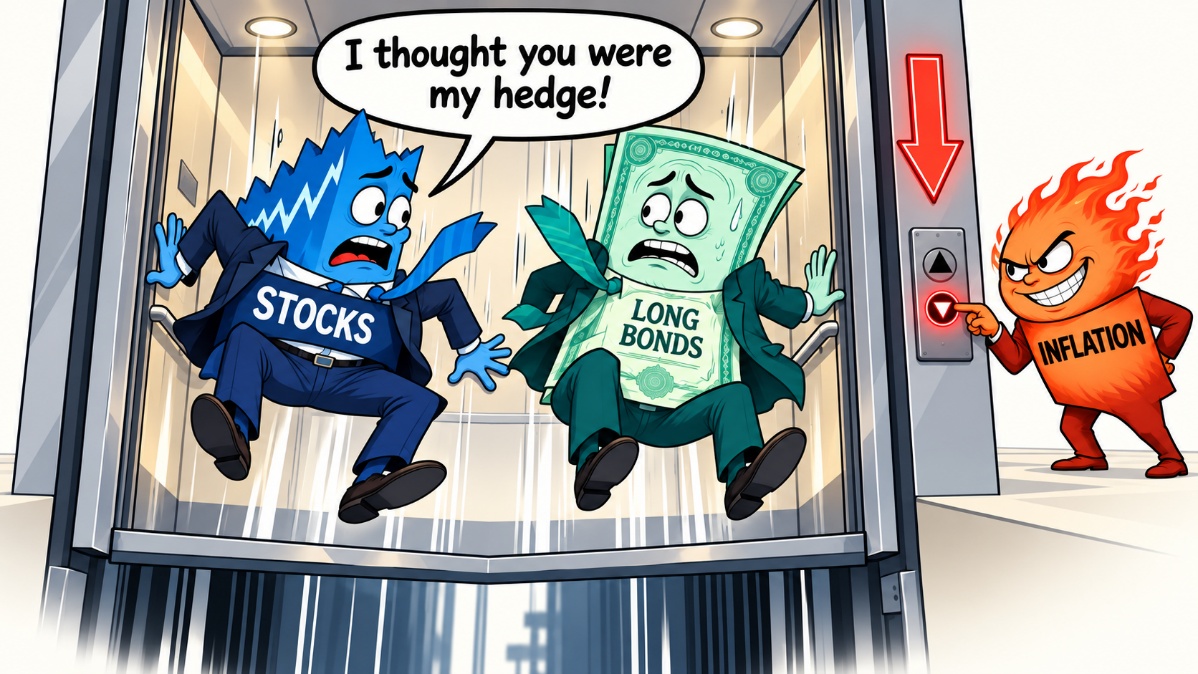
Stocks fall. Bonds rise. The portfolio finds its balance.
For many investors, that was the familiar logic behind a balanced portfolio. Equities drove growth, while bonds provided income and acted as ballast when markets became unsettled. Long-duration government bonds, in particular, became a trusted counterweight to equity risk.
There was good reason for that confidence. When the economy slowed, corporate earnings came under pressure and stocks sold off. Inflation often eased alongside growth, giving central banks room to cut rates. Bond yields declined, prices rose, and duration helped cushion the portfolio.
Following the global financial crisis, central banks added large-scale bond purchases to that response, providing further support for longer-dated bonds.
It worked often enough that investors could begin to think of duration as the opposite of equity risk. But that relationship came with a condition: inflation needed to give policymakers room to respond.
The Environment that Made it Work
The Great Moderation—from roughly the mid-1980s to 2007—was a period of lower inflation and reduced economic volatility. It also sat within a much longer decline in interest rates, stretching from the early 1980s into the pandemic era.
Think about the starting point. U.S. overnight rates were around 20% at their early-1980s peak. By the aftermath of the financial crisis, they were near zero. That journey created a substantial tailwind for bonds.
Other forces helped. Globalization expanded the supply of labour and goods. Technology improved efficiency. Baby boomers moved through their working, earning and saving years. Inflation became better anchored, and many governments carried lower debt burdens than they do today.
Bonds could earn income, benefit from falling yields and provide protection during many growth-driven downturns. That was an attractive combination.
There is an important distinction, though. The long bond rally and bonds’ tendency to move opposite to stocks were not identical stories. The negative relationship between U.S. stock and bond returns became more consistent from the late 1990s. It was especially strong during the period that shaped many investors’ expectations today.
The 60/40 portfolio existed well before then. But much of the modern confidence in its behaviour was reinforced by those favourable decades. With better data and more sophisticated portfolio tools, we became increasingly precise at measuring relationships that still depended on the economic environment.
Inflation is the Great Equalizer
Now consider a different kind of slowdown.
Growth weakens, but inflation stays elevated. Households and businesses are under pressure, yet prices continue to rise. Cutting rates might support activity, but it could also stimulate demand and make inflation harder to control.
Central banks face an uncomfortable choice. They may need to keep policy restrictive—or raise rates further—even as the economy loses momentum.
That is where the familiar stock–bond relationship can break down.
Higher yields push bond prices lower. At the same time, higher financing costs weigh on businesses, and higher discount rates pressure equity valuations. Stocks and bonds can fall together because both are responding to the same inflationary shock.
The chart below shows how different the portfolio experience can become. During 1986–2020, combining stocks and bonds offered a pronounced reduction in realized volatility. During 2021–2025, adding bonds reduced realized returns without providing the same degree of risk reduction.
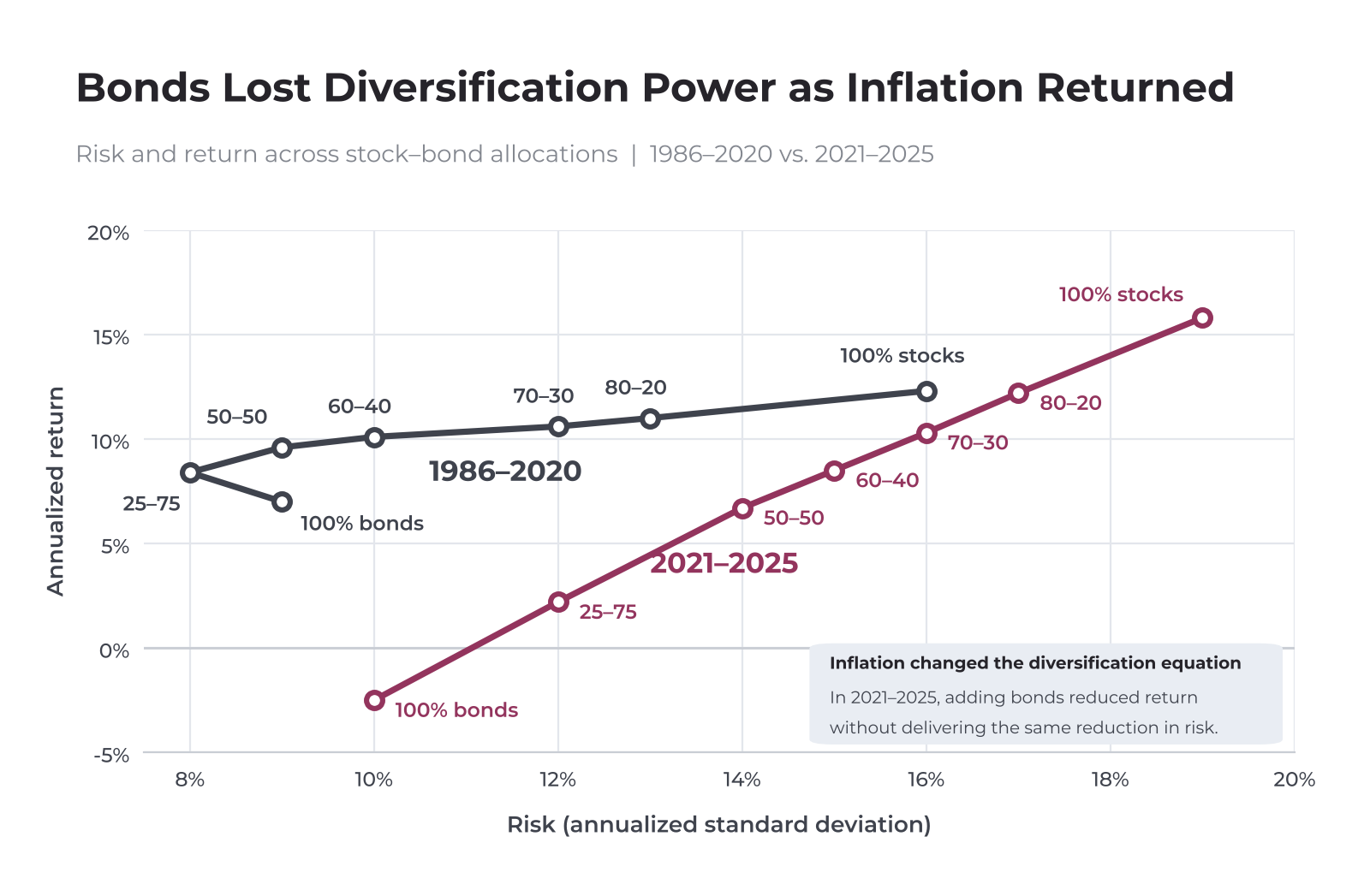
Source: Aswath Damodaran, NYU Stern; Financial Times calculations. Allocations are shown as stocks–bonds. Values are approximate.
The periods differ in length, but the comparison makes the point: owning different asset classes does not necessarily mean owning different economic risks. A portfolio can hold both stocks and bonds and still be heavily exposed to inflation.
So, do bonds still deserve a place?
As a former institutional bond manager, I would hesitate to say bonds are useless. That simply is not true.
The roughly four-decade secular bond bull market has ended. Investors can no longer assume that a persistent decline in yields will provide the same tailwind. But bonds still offer income, liquidity and valuable protection under certain conditions.
Long-duration government bonds can perform well when growth weakens and inflation subsides. They can also benefit when uncertainty eases and investors require less compensation for holding longer maturities.
A sustained de-escalation of the U.S.–Iran conflict is one possible example. If it reduces pressure on energy prices and supply chains, inflation expectations could ease. Investors may also demand less additional term premium. Lower yields would then support bond prices.
That outcome is not assured, and fiscal concerns or continued issuance could offset some of the benefit. Nevertheless, it is a credible scenario in which duration could contribute meaningfully.
Higher starting yields also change the conversation. Investors are being offered more income for holding bonds. At some point, that income becomes attractive enough to draw capital from investors willing to trade some potential equity growth for more predictable cash flows.
Those buyers could help put a ceiling on near-term yields. We cannot identify that ceiling precisely, but higher yields create their own source of demand.

Source: Bloomberg, USGG10YR Index. Historical values are approximate. Trendline connects selected major highs; dashed segment is an illustrative extension. A breakout suggests a regime change, but does not establish its permanence.
The Allocation Deserves More Thought
The challenge ahead is that bonds may be a less dependable hedge against equities when inflation remains a dominant risk.
Higher government debt, geopolitical uncertainty and substantial capital spending can all complicate the outlook. AI may eventually deliver productivity gains that support growth and improve debt sustainability. In the meantime, building the infrastructure requires capital.
A portfolio needs to be prepared for more than one outcome.
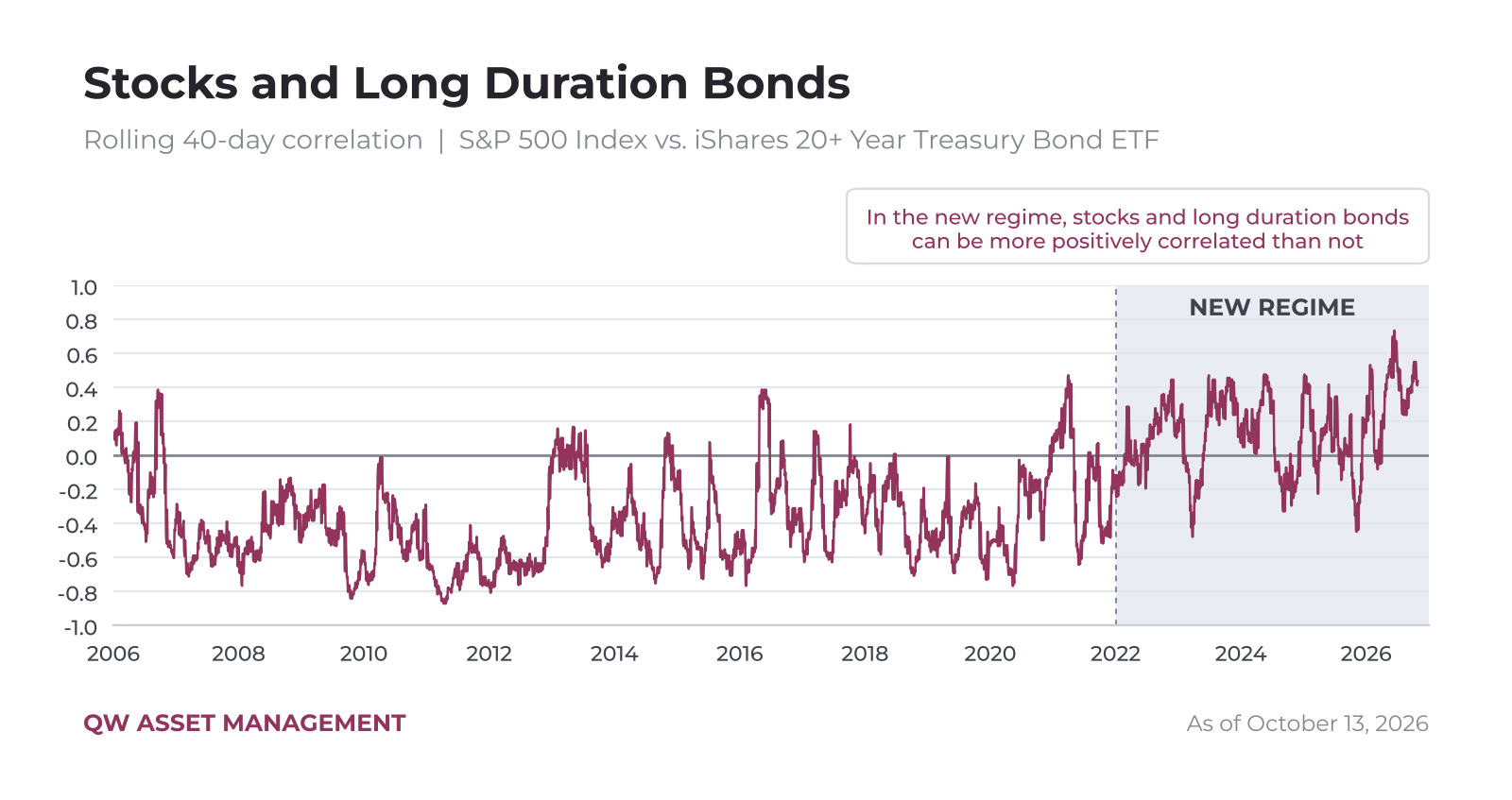
Source: Bloomberg. 13 October 2006 – 13 October 2026.
Within fixed income, inflation-linked bonds can help preserve purchasing power, while floating-rate securities reduce exposure to rising interest rates. Selected securitized credit can broaden income sources and contribute to resilience through collateral and structural protections. Each brings its own risks, so the details matter.
Beyond fixed income, multi-strategy funds and other exposures with low sensitivity to traditional markets can complement stocks and bonds. They are not replacements for bonds’ income, liquidity or potential protection in a disinflationary downturn. Their purpose is to give the portfolio additional ways to respond when the traditional relationship becomes less helpful.
Duration still belongs in the portfolio. The more important question is how much long-duration exposure to hold—and what sits alongside it.
That decision deserves a clear view of the economic risks being taken, the compensation available and the conditions in which each investment is expected to contribute.
Disclosure:
Quintessence Wealth, a registered Portfolio Manager in Alberta, British Columbia, Manitoba, New Brunswick, Newfoundland and Labrador, Nova Scotia, Ontario, Prince Edward Island, Quebec, and Saskatchewan, an Investment Fund Manager in Newfoundland and Labrador, Ontario, and Quebec, and an Exempt Market Dealer in Alberta, British Columbia, Manitoba, New Brunswick, Newfoundland and Labrador, Nova Scotia, Ontario, Quebec, and Saskatchewan. The Ontario Securities Commission (OSC) is the principal regulator for Quintessence Wealth.
The opinions expressed are based on an analysis and interpretation dating from the date of publication and are subject to change without notice. The information contained herein may not apply to all types of investors. The opinions in this market outlook were prepared by Alfred Lee as of the date of this report and are subject to change without notice. The opinions expressed in this report are that of the author and do not necessarily reflect the opinion of Q Wealth as a firm. This report is not to be construed as an offer or solicitation to recommend Q Wealth products to clients.